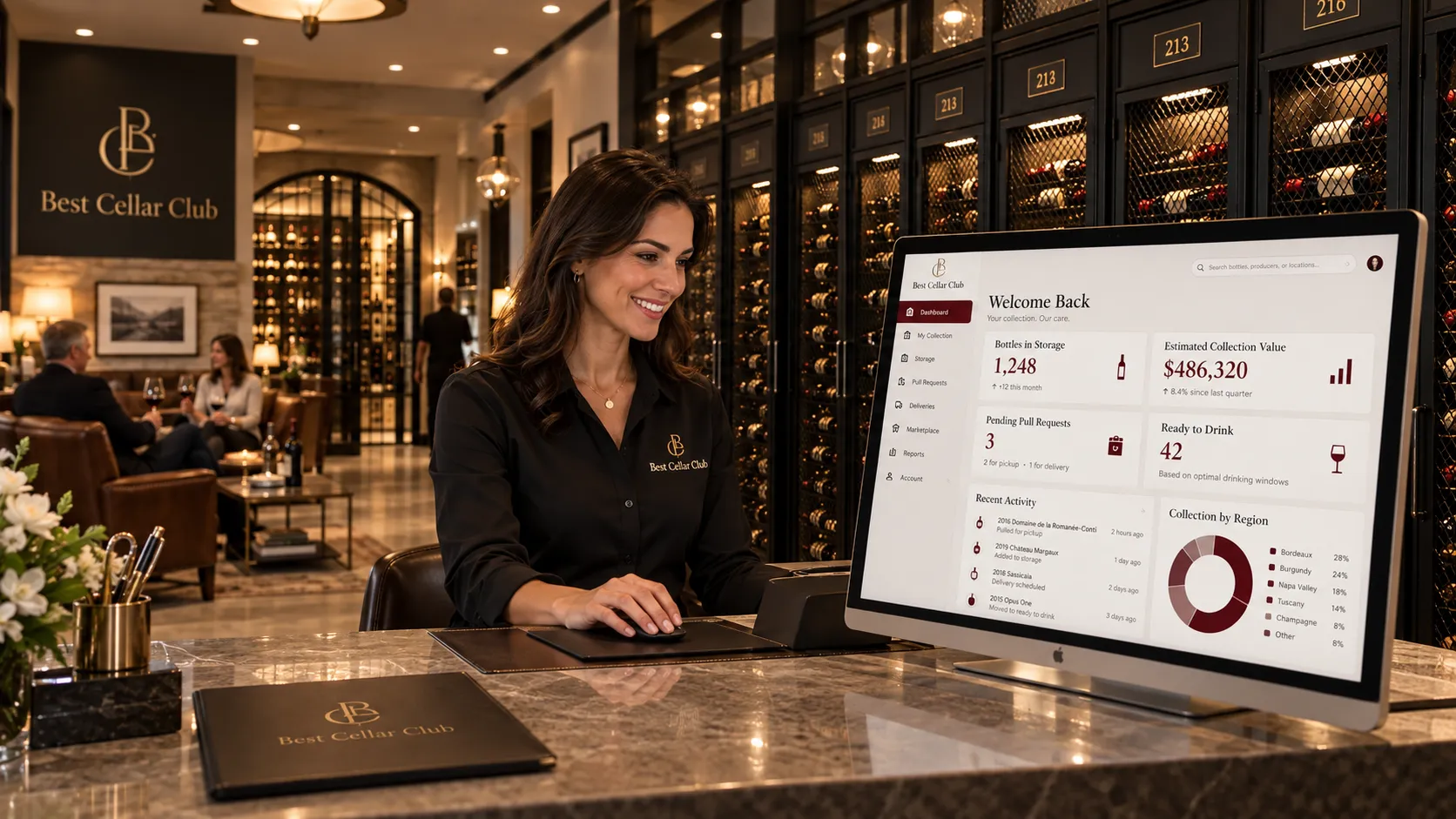
Choosing software for a wine storage business is a bigger decision than it looks. The system you pick will hold the records of every bottle you are responsible for, shape how your staff work every day and determine what your members see. Changing later is possible, but it is disruptive, so it pays to ask hard questions at the start.
The options generally fall into a few groups: spreadsheets, general warehouse or inventory software adapted for wine, consumer cellar apps and platforms built specifically for storage operators. Each has its place. The questions below will help you see which one actually fits the way your business works, rather than the way a sales demonstration makes it look.
1. Does it track every bottle individually?
Some systems record wine by line item: six bottles of a wine, in one place. That works until the six bottles end up in three different bins, two are pulled and one is broken. A system that records each bottle individually, with its own location and history, stays accurate as bottles move around, which they always do.
2. Can staff find any bottle in under a minute?
Ask to see this in the demonstration, with a realistic amount of data. How are locations structured? Can staff search by wine, by member or by bin? Can they scan a bottle or bin label with a phone? Can they type part of a bin address and get the right one immediately, instead of scrolling through thousands of options? Speed at locating bottles is what separates a system your staff love from one they work around.
3. What do members see, and whose name is on it?
Members increasingly expect to see their own collection. Ask what the member experience looks like on a phone, what information it shows and how requests work. Then ask whose brand members see. A platform that shows your name and colors keeps the relationship with you. One that shows the software company’s brand gradually shifts that relationship elsewhere.
4. Does it handle both lockers and concierge storage?
Many businesses offer both, or plan to. Lockers and concierge storage work very differently. Lockers are about access and assignment. Concierge storage is about tracking every bottle on the member’s behalf. Make sure any system you consider handles both properly, including members who use both at once, without forcing awkward workarounds.
5. How are pulls and releases handled?
Pulling bottles is one of the most frequent tasks in a concierge operation and one of the easiest places for mistakes. Look for member requests that arrive tied to specific bottles, a pick list that shows staff exactly where to go, and signed release forms recording who took what and when. A clear chain of custody protects both you and your members.
6. Does billing match how you actually charge?
Storage pricing varies widely: per bottle, per box, per case, by locker size, with minimums and tiers. Check that the system can bill the way you price rather than forcing you to change your pricing to suit the software. Ask how invoices are created, how members see and pay them, and whether you can export figures to your accounting system.
7. Can you get your data out?
This question is often forgotten and it matters enormously. Your records belong to you. Make sure you can export complete inventories, per member and in total, into a standard format such as Excel, whenever you want and without asking the vendor. Members, attorneys and insurers will ask you for lists regularly, and you should be able to produce one in minutes.
8. How is your data kept separate and secure?
If a platform serves many storage businesses, ask how each one’s data is kept separate. Your members’ information and collections must never be visible to another operator, under any circumstances. Ask how access is controlled for your own staff, whether different roles see different things, and what records are kept of changes.
9. How fast is intake?
Intake is where software either saves or wastes the most time. Look for tools that speed up entering bottles, such as reading a label from a photograph and filling in details automatically. Look for batch entry, so that a delivery of a dozen bottles for one member going into one bin doesn’t require selecting the member and bin twelve times. Ask to time a realistic intake in the demonstration.
10. Can you communicate with members from it?
Regular, accurate communication keeps members engaged. Ask whether the system can send members personalized updates using their real, current figures, such as bottle counts, collection values and balances, without you copying numbers by hand. Ask how messaging between members and staff works, and whether members can see events and news in their portal.
11. What about valuations and insurance?
Members increasingly want to know what their collection is worth, for insurance or estate planning. Ask whether the system can provide reference values for bottles and produce a collection summary or insurance schedule. Ask where the values come from, and make sure the software is honest about the difference between a reference value and a formal appraisal.
12. Who built it, and will they help you move?
Finally, ask who designed the software and whether they have ever run a storage operation. Software built by people who understand a cellar’s daily realities tends to get the small details right, from how bins are labeled to how a pull is handed over. Ask what help is available for moving your existing records, and talk to current customers about their experience.
Red flags in a demonstration
Watch for a few warning signs. A demonstration that only ever uses a small, perfect sample account, never one with thousands of bottles. Answers that begin with “that’s on the roadmap” for features you need today. Difficulty exporting your own data, or a suggestion that you would need to pay to get it out. Pricing that is unclear, or that changes significantly once you mention how many bottles or members you have.
Be wary, too, of software that requires your staff to work around it. If a salesperson explains that a common task is handled with a manual workaround or a separate spreadsheet, imagine your team doing that dozens of times a day. Small frictions in a demonstration become large frustrations in daily use.
Finally, notice how the vendor talks about your members. Software that treats your members as its own users, with its own marketing and branding aimed at them, has different interests from yours. The right partner stays in the background and makes your business look good.
Putting the answers together
No system will be perfect for everyone, and the right choice depends on your size, your model and your plans. A small locker operation might manage well with simpler tools for a while. A growing concierge business with hundreds of members will usually need something built specifically for storage.
Take these twelve questions into every demonstration, ask to see the answers working rather than hearing them described, and pay attention to how confidently each vendor responds. The right software should make your business feel calmer, your staff faster and your members better informed. If it doesn’t do those three things, keep looking.
One practical suggestion to close. Before any demonstration, prepare a small real-world test: thirty or forty bottles from an actual member, with a few awkward cases such as a magnum, a mixed case split across two bins and a bottle already out on a pull. Ask each vendor to enter them, move them, pull one and produce the member’s list. A sample like that tells you more in half an hour than a polished tour of a perfect demo account ever will.
Built for this. We built Best Cellar Club inside a working cellar in Atlanta, and it answers each of these twelve questions. The fairest test is to ask them of every option you’re considering, ours included, and see which answers hold up in a live demo. Take the 2-minute tour →